
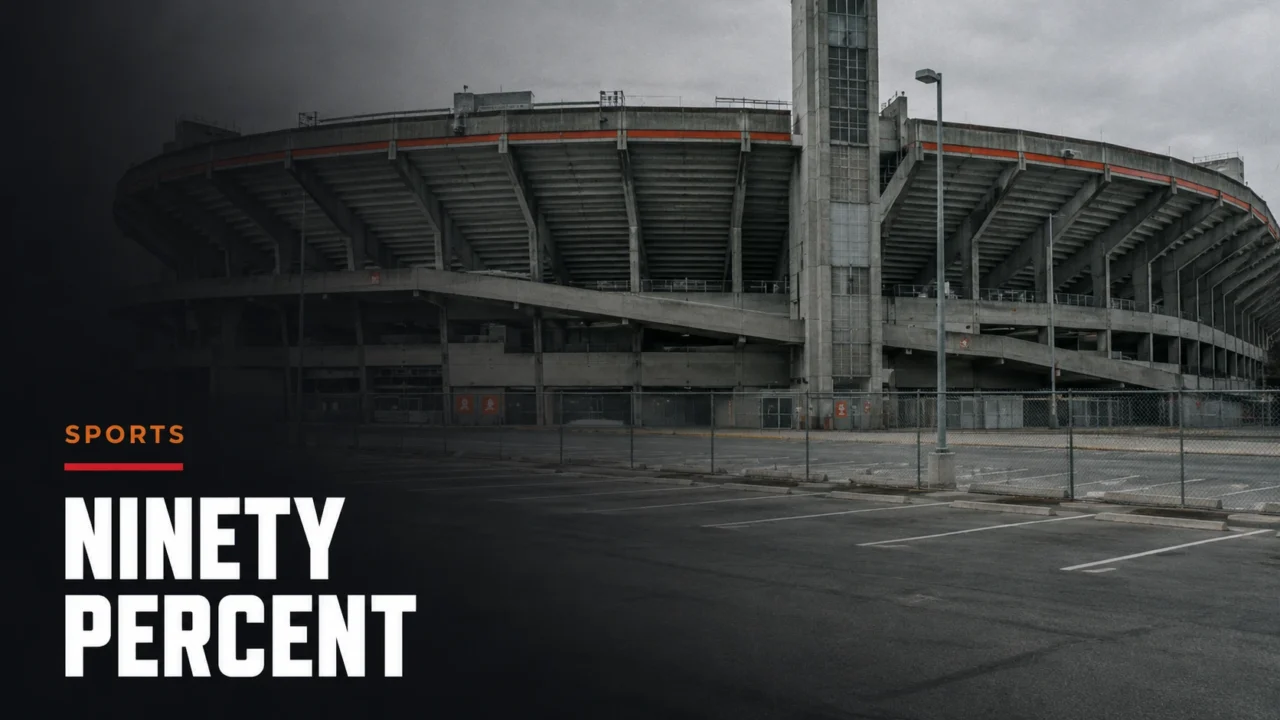
A city announces a new arena, a team announces a contribution, and the reported split sounds reasonable. Working out who pays for stadiums means looking past that headline number to the debt underneath it, because the financing structure decides the answer and the press conference rarely describes it.
Most large venues are built with municipal bonds. A city or state borrows the money, the stadium gets built, and the debt is repaid over decades from tax revenue — which means the public contribution is not a one-off cheque but a repayment obligation lasting longer than most players’ careers.
The strange part is that a federal tax rule written to stop this is the reason the burden falls where it does.
The money comes from bonds, not from ticket sales
A stadium is financed like a bridge. The government issues bonds, investors buy them, and the proceeds pay the contractors. What differs is who ends up servicing the debt.
Repayment comes from a dedicated tax stream, and the choice of stream is where the politics happens. Hotel and rental car taxes are popular because they fall largely on visitors who do not vote locally. Sales taxes, ticket surcharges and general funds appear when that is not enough.
The team’s own “contribution” is a separate matter, often covering construction costs while the public side carries land, infrastructure and the borrowing.
None of this depends on the stadium succeeding. Debt service is due whether the team wins, loses, draws crowds or relocates, and it ranks alongside the city’s other obligations — which is to say it competes with schools and street repairs for the same revenue.
Why the federal government is involved at all
Municipal bonds carry a tax advantage: the interest paid to bondholders is exempt from federal income tax. Investors accept a lower interest rate in exchange, which lowers the borrowing cost for the city.
That discount is funded by the federal treasury, which collects less tax than it otherwise would. The subsidy is real but indirect, and it never appears as a line item in any stadium deal.
It also means a taxpayer in one state helps finance a venue in another, without any local vote on it. A 2012 Bloomberg analysis put the annual cost to the US Treasury at around $146 million.
The 1986 rule that was meant to stop this
Congress noticed. The Tax Reform Act of 1986 set out to strip the tax exemption from bonds that mainly benefit private businesses, and a professional sports team is plainly a private business.
The mechanism was a two-part test. A bond becomes a taxable “private activity bond” if it fails both a private business use test and a private security or payment test — the second asking whether more than 10% of debt service is secured by, or paid from, private business property.
Fail both and the exemption disappears. The intent was straightforward: if a stadium is a commercial venture, it should borrow at commercial rates, and the federal government should stop quietly discounting the interest on buildings that enrich private franchises.
How the ten percent rule backfired
The drafting produced the opposite of the intention, and this is the part almost no coverage explains.
Because a bond only becomes taxable when it fails both tests, a city can keep the exemption by deliberately failing just one. Stadium bonds clear the private business use test easily — the team obviously uses the building — so the exemption survives by keeping stadium-generated revenue below the payment threshold.
As the Villanova Sports and Entertainment Law Journal puts it, a government using tax-exempt bonds to finance a stadium “must have another source of revenue to fund ninety percent of the payments on the stadium”.
Read that again. To keep the federal subsidy, at least 90% of the debt has to be repaid from something other than the stadium. The rule intended to end public financing instead guaranteed it: rent, naming rights and ticket revenue cannot service the bonds without breaching the threshold, so general taxation must.
There is a second squeeze. The same journal notes that the rule pushes governments into “requiring favorable rental terms to the sports teams in order to meet the ten percent threshold” — the city must charge the team little enough that stadium revenue stays under 10%, which is a structural reason for the cheap leases later cited as evidence of municipal incompetence.
So the arrangement holds the public side to roughly a tenth of what the building earns while leaving it responsible for nine tenths of what the building cost.
The debt outlives the tenant
A bond issued over thirty years commits a city for longer than any lease is likely to hold, and longer than the building will stay competitive. Both of those gaps have consequences that the original vote never priced.
Cities have found themselves servicing debt on venues their team had already left, and in several cases on venues that had been demolished — the borrowing survives the concrete, because retiring a municipal bond early is expensive and sometimes not permitted at all.
The second gap is renewal. Modern stadium leases frequently oblige the public owner to fund upgrades partway through the term, so a city can still be repaying the original construction while borrowing again for a refurbishment the contract requires.
What the economics actually show
The case made for these deals is economic development: construction jobs, visitors, a revived district, new tax revenue paying the subsidy back. Research has been unusually consistent in rejecting it, and the Brookings analysis of the question concluded that a new sports facility has an extremely small, perhaps even negative, effect on overall economic activity and employment.
The reason is substitution. Money spent at a game is mostly money not spent at a restaurant, a cinema or a bowling alley in the same metropolitan area, so the regional total barely moves even when the district around the stadium visibly improves.
Even the strongest example disappoints. The same analysis found that Baltimore’s Oriole Park, widely treated as the model of a successful downtown ballpark, generated only about $3 million a year against a $200 million investment.
Economists agree on this to a degree they rarely reach on anything. Surveys of the profession have found around 86% supporting the elimination of public subsidies for professional franchises, and in a 2017 poll 83% judged that the cost to the public outweighed the benefits.
The honest caveat is that these studies measure regional economic aggregates. They are not designed to price civic identity, and a city that knowingly buys a public amenity at a loss is making a different argument — one that is defensible, but almost never the argument actually made.
Why cities agree anyway
If the economics are this clear, the persistence needs explaining, and the explanation is bargaining position rather than ignorance.
Leagues in the United States control the number of franchises and where they sit. A city cannot respond to an unreasonable demand by acquiring a competing team, because no such team is available.
What the team can do is move. The credible threat of relocation is the whole of the leverage, and it has been carried out often enough to be believed.
Timelines make it worse. A mayor negotiating a thirty-year bond will face voters long before the debt matures, so the ribbon-cutting and the repayment fall on different administrations.
Referendums, where they happen, are a genuine constraint. They are also the reason many deals are routed through authorities and agencies that can issue debt without a public vote, or split across funding streams small enough that none individually triggers one.
The numbers, and why they are slippery
Totals vary between studies, mostly because researchers disagree about what to count. Land, infrastructure, foregone property tax and the federal exemption can all be included or left out.
One widely cited accounting put public subsidies for 99 facilities between 1990 and 2001 at roughly $17 billion, averaging about $1.6 billion a year.
Those figures are usually restated in later dollars — the $17 billion becomes around $24 billion in 2018 terms — which quietly makes the comparison depend on how inflation is measured and on which index someone chose.
Treat any single headline total with care. The direction of travel is not in dispute and neither is the sign of the number; the precise magnitude usually is, and it moves with the accounting choices.
What to look for in the next stadium deal
The announcement will lead with a split, and the split is the least informative number available. Four questions get closer to who is actually paying.
- Is the public share borrowed, and over how many years? A $500 million contribution repaid over thirty years is a much larger commitment than it sounds
- Which tax stream services the debt, and what happens if it underperforms — does the general fund cover the gap?
- What rent does the team pay, and who keeps naming rights, parking and concessions? The ten percent rule pushes all of this toward the team
- Who owns the building at the end, and who pays for renovations halfway through the lease?
The last one matters more than it appears. Stadium leases increasingly include public obligations for upgrades, which is how a city finds itself paying twice for the same building.
Sport is not unusual in attracting public money for private benefit. It is unusual in how cheerfully the arrangement is announced, and in how rarely the borrowing that funds it gets described as what it is: a transfer from taxpayers to a business under no obligation to stay.
The underlying habit is familiar to anyone who follows the sport itself, where clubs routinely commit money they do not yet have against revenue they hope will arrive — the same optimism that drives spending during the football transfer window.
For a related mechanism, see our explainer on the International 2026 playoff schedule.
For a related mechanism, see our explainer on how interchange fees work.