
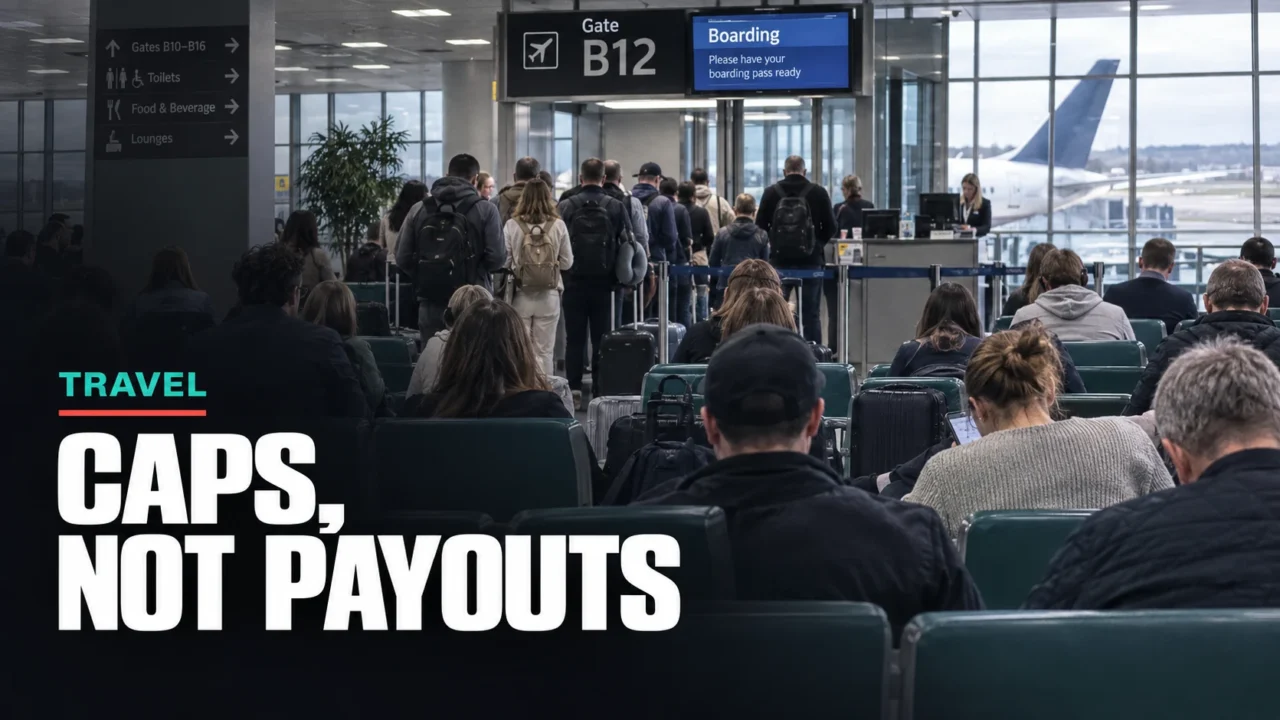
The gate agent asks whether anyone would take $400 and a later flight. A few hands go up, the offer stops rising, and the aircraft departs full. Understanding how airline overbooking works means understanding that this small auction is the entire system operating exactly as designed.
Airlines sell more seats than the aircraft holds because a predictable share of passengers never turns up. When the forecast is wrong and everyone arrives, the airline has to buy a seat back — first by asking for volunteers, and only then by removing someone who did not agree.
The difference between those two outcomes is worth a great deal of money, and almost everything in the regulations is built around keeping the first one common and the second one rare.
Why airlines sell seats they do not have
A no-show costs the airline the entire value of an empty seat on a flight that departs anyway. Fuel, crew and landing fees are already committed, so an unsold seat at the moment of departure earns nothing and can never be recovered.
Overselling is the hedge. Carriers forecast the no-show rate for a specific route, at a specific time, on a specific day, using the history of that same flight, then release extra seats against it.
The forecast is route-specific because passenger behaviour is. A Tuesday morning business route with flexible tickets produces far more no-shows than a holiday charter where everyone paid in advance and nobody can rebook.
When the forecast holds, nobody notices and the aircraft leaves full. When it misses, the airline has oversold a flight it now has to fix at the gate.
The auction comes first, and that is a legal requirement
In the United States the process is set out in Part 250 of the federal aviation regulations, and it is more prescriptive than most passengers realise.
Carriers must ensure that the smallest practicable number of people are denied boarding involuntarily, and before using any boarding priority at all they must request volunteers. The regulation defines a volunteer as someone who responds to that request and willingly accepts the carrier’s offer of compensation — and the phrase it uses is “in any amount”.
Those three words carry most of the economics. A volunteer’s price is whatever they agree to, which means the airline is free to open low and raise the offer until enough hands go up.
Why the airline rarely pays the regulated amount
Here is the part that the compensation-claim industry has little interest in explaining. The statutory scale applies only to passengers denied boarding involuntarily. The gate auction exists to make sure there are none.
An airline running the auction properly will keep raising its offer until the number of volunteers matches the number of seats it needs. Provided that price stays below what the regulation would cost it, the airline is better off paying it — and it usually is.
The result is a system where the regulated figures function as a ceiling the airline negotiates beneath, rather than a payment most bumped passengers ever see.
There is a trap inside the definition, and it catches people. Accepting the airline’s money does not make you a volunteer. The regulation treats any passenger who did not respond to the request for volunteers as denied boarding involuntarily even if that passenger accepts the denied boarding compensation. What matters is whether you agreed to give up the seat.
What the rules actually owe an involuntary passenger
Compensation is keyed entirely to how late the replacement flight gets you there, measured against your original planned arrival. The scale below is worth reading closely, because it is routinely reported backwards.
| Delay at destination | Compensation owed |
|---|---|
| 1 hour or less | Nothing |
| More than 1, less than 2 hours | 200% of the fare, or $1,075 — whichever is lower |
| 2 hours or more | 400% of the fare, or $2,150 — whichever is lower |
Those dollar figures are caps, not entitlements. The regulation says 200% or 400% of the fare, “or $1,075” and “or $2,150”, whichever is lower — and the lower of the two is what the airline owes.
A passenger on a $180 fare who arrives three hours late is owed 400% of $180, which is $720 — not $2,150. The larger number only appears when four times the fare exceeds it, which requires an expensive ticket.
If the airline gets you there within an hour of the original arrival time, the regulation requires nothing at all, however annoying the experience was.
One neat provision covers award tickets. For a passenger holding a zero-fare ticket, the fare used in the calculation is the lowest cash price paid for a seat in the same class on that flight, so a redemption booking is not valued at nothing.
Who gets chosen, and it is not random
When the auction fails, someone has to be selected, and every carrier is required to publish written priority rules for doing it.
The regulation does not dictate those rules, but it does list the factors a carrier is permitted to weigh:
- What time the passenger checked in
- Whether they had a seat assignment before reaching the gate
- The fare they paid
- Their frequent-flyer status
- Disability, or status as an unaccompanied minor
The pattern is not subtle. Late check-in, cheap ticket, no status and no seat assignment is the profile most likely to be selected, and each of those is a proxy for how much the airline stands to lose by upsetting that passenger.
The rules are constrained, though. They must be written to be understandable to an average passenger, and they may not give any person an undue preference or subject anyone to unreasonable prejudice.
Payment is due at the airport, in cash
Compensation for involuntary denied boarding is not a claim to be filed later. The carrier must tender cash or an immediately negotiable cheque on the day and at the place the denied boarding happens.
The single exception is timing. If the replacement flight leaves before payment can be prepared, the airline has 24 hours to get the money to the passenger.
Anyone denied boarding involuntarily is also owed a written statement, handed over immediately, explaining the terms and limits of the compensation and setting out the carrier’s boarding priority rules. The same statement has to be given to anyone who asks for it at a staffed ticket desk or a boarding gate, which makes the priority rules a published document rather than an internal one.
A travel voucher is not the same thing. Vouchers belong to the voluntary auction, where the passenger is free to accept whatever is offered.
The caps move with inflation
The $1,075 and $2,150 figures are not fixed in the statute. The Department of Transportation reviews them every two years and adjusts them using the Consumer Price Index for All Urban Consumers, rounding the result to the nearest $25. The cycle is deliberately aligned with the reviews of domestic baggage liability limits, and the higher figure is simply twice the lower one.
That detail is more interesting than it looks. The value of a passenger’s protection is indexed to the same contested statistic that shapes wage negotiations and benefit payments — the one whose largest component is an imputed rent, as how inflation is measured sets out.
If the index understates what households experience, the ceiling on denied boarding compensation drifts downward in real terms without anybody voting on it.
Overbooking is not the same as a cancellation
This is the most common misunderstanding, and it decides whether any of the above applies at all. Part 250 governs oversales — flights where more passengers hold confirmed seats than the aircraft can carry. A cancelled flight, a delayed flight or a missed connection is a different matter, covered by the airline’s own contract of carriage rather than by this compensation scale.
Equipment changes sit awkwardly between the two. When an airline substitutes a smaller aircraft, passengers get removed for reasons that look identical from the gate but are treated differently in the rules, which contain specific exceptions.
The European scheme works on a different principle again, paying fixed amounts by flight distance rather than as a multiple of the fare, which is why the same disruption can produce very different outcomes on either side of the Atlantic.
What changed after 2017
The practice drew sustained scrutiny after a passenger was forcibly removed from a United Express flight in 2017 to make room for crew members who needed to reach the next airport.
The video did more to change airline behaviour than any regulation. Carriers raised the maximum they authorise gate staff to offer volunteers, some by a large multiple, and several stopped removing passengers once they were already seated.
That response is the clearest evidence for how the system really works. Faced with reputational cost, airlines did not lobby to change the compensation scale — they simply bid higher in the auction, because the auction was always the cheaper instrument.
Involuntary denied boarding remains rare, and it is rare by construction rather than by luck.
What the numbers at the gate are telling you
An opening offer is a probe, not a valuation. It reflects what the airline hopes will clear, and the ceiling authorised for that agent is usually far above it.
Three things determine whether waiting is sensible: how many seats the airline still needs, how many hands went up at the last offer, and how firm your own arrival time is. The first two are visible from the gate area, and airlines that need several volunteers on a full evening flight have little room to stop bidding.
The comparison worth making is against what the seat cost in the first place, since a compensation offer that exceeds the fare is a better return than most of the tactics for finding a cheaper flight ever produce.
For a related mechanism, see our explainer on how music royalties work.
For a related mechanism, see our explainer on how plane crashes are investigated.
For a related mechanism, see our explainer on why flights get delayed.