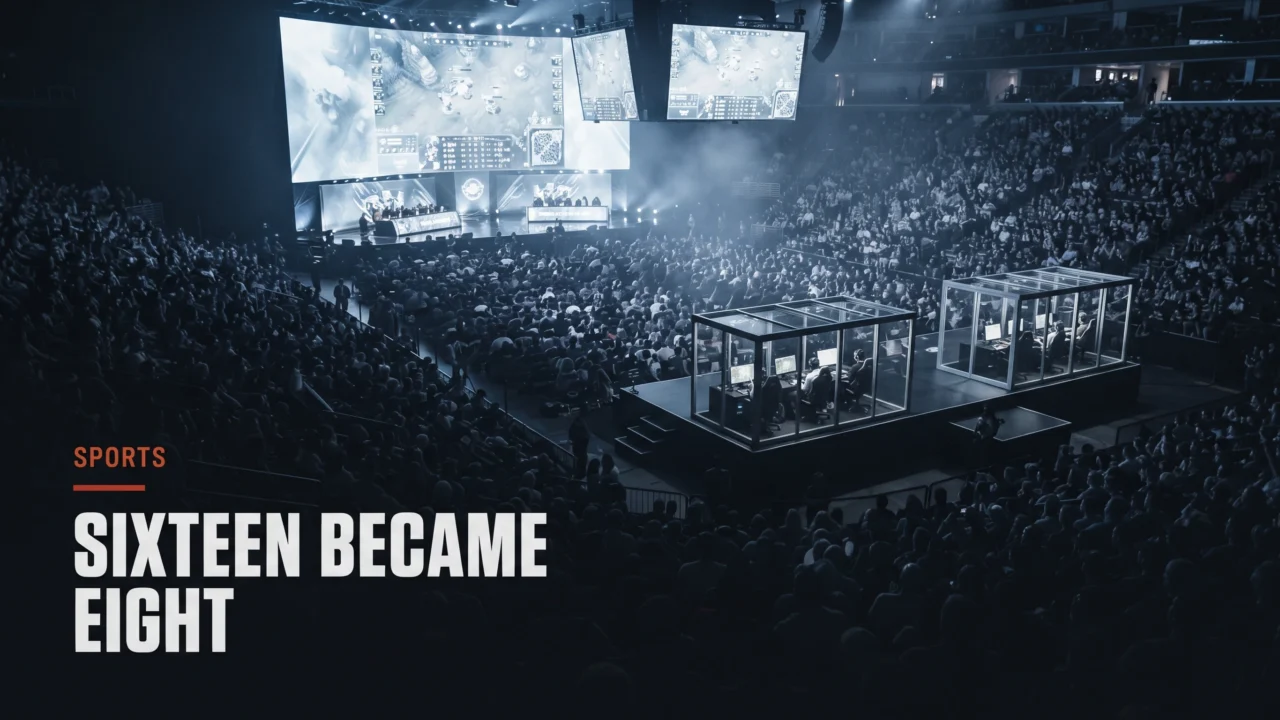
The group stage in Shanghai has finished and sixteen teams have become eight. The International 2026 playoff schedule runs from 20 to 23 August at the Oriental Sports Center, and TEAM VISION arrives at it as the only side that came through the opening phase without losing a series.
Three teams went through to the main event directly. Five more survived a single elimination match on 16 August. Three were knocked out before that round began, and China, hosting the event, has nobody left in it — all three of its representatives are gone.
What follows is the full record of how the field was cut, and what the bracket looks like from here.
How the group stage worked
The opening phase was not a round robin. It ran on the Swiss system, which pairs teams by record rather than by group, so a side on two wins meets another side on two wins.
The design matters because it changes what a result means. Nobody plays every opponent, and no team can be carried by an easy group — each win raises the difficulty of the next match, and each loss lowers it.
Five rounds of best-of-two series ran from 13 to 16 August. Because best-of-two allows a drawn series, map difference does a great deal of the sorting, which is why the standings separate teams on identical series records.
That is visible at the top of the table. Nigma Galaxy and Team Liquid both finished 4-1, and Nigma took second place on an 8-2 map record against Liquid’s 9-5.
The bracket then split the sixteen teams three ways.
- Finish in the top three and you go straight to the playoffs
- Finish fourth to thirteenth and you play one best-of-three elimination match for a place
- Finish in the bottom three and you are out
Final group stage standings
| # | Team | Series | Maps | Outcome |
|---|---|---|---|---|
| 1 | TEAM VISION | 4-0 | 8-2 | Direct to playoffs |
| 2 | Nigma Galaxy | 4-1 | 8-2 | Direct to playoffs |
| 3 | Team Liquid | 4-1 | 9-5 | Direct to playoffs |
| 4 | Team Spirit | 3-2 | 6-5 | Elimination round |
| 5 | Iron Wing | 3-2 | 8-6 | Elimination round |
| 6 | Team Falcons | 3-2 | 8-7 | Elimination round |
| 7 | Aurora Gaming | 3-2 | 7-5 | Elimination round |
| 8 | LGD Gaming | 3-2 | 7-6 | Elimination round |
| 9 | BoomBoys | 2-3 | 5-7 | Elimination round |
| 10 | Vici Gaming | 2-3 | 4-8 | Elimination round |
| 11 | Team Yandex | 2-3 | 7-7 | Elimination round |
| 12 | Team Resilience | 2-3 | 7-6 | Elimination round |
| 13 | GamerLegion | 2-3 | 6-6 | Elimination round |
| 14 | Xtreme Gaming | 1-4 | 3-8 | Eliminated |
| 15 | OG | 1-4 | 2-9 | Eliminated |
| 16 | HULIGANI | 0-4 | 2-8 | Eliminated |
The three who went straight through
TEAM VISION finished 4-0 in series and 8-2 in maps, the only side to come through the group stage without dropping a series. That record bought them four days off while everyone else played for survival.
Nigma Galaxy matched that 8-2 map record on a 4-1 series line, which is the cleanest reading of form in the whole table — a single bad series rather than a run of close ones.
Team Liquid took the third automatic place on 4-1, though their 9-5 map record shows a rougher route. They won more maps than anyone and lost more than the two teams above them.
The gap between third and fourth is the widest consequence in the format. Third meant rest; fourth meant one best-of-three with the tournament on it.
Ten teams, five tickets
Everyone who finished on 3-2 or 2-3 dropped into a single elimination round on 16 August: ten teams, five best-of-three series, winners through and losers out. No second chance, and no allowance for where a team had finished in the group.
Five came through — Team Spirit, Iron Wing, Team Falcons, BoomBoys and Team Yandex.
Five did not: Aurora Gaming, LGD Gaming, Vici Gaming, Team Resilience and GamerLegion.
The seeding produced one obvious oddity. BoomBoys and Team Yandex both arrived on 2-3 records, below Aurora Gaming and LGD Gaming on 3-2, and both are now in the main event while the higher seeds are not. A single series is a small sample, which is exactly the criticism made of this stage every year.
The exits that carry the most history
OG finished fifteenth on a 1-4 record with a 2-9 map line, the second-worst in the field. This is the organisation that won the event in 2018 and again in 2019, still the only back-to-back champion in its history.
Xtreme Gaming went out one place above them. HULIGANI finished last, the only team in the field not to win a single series, on a 0-4 record.
Team Spirit, by contrast, went the hard way and survived. They finished fourth, dropped into the elimination round and came through it, which is a familiar pattern for a roster that has twice left this tournament holding the Aegis.
The playoff bracket
Eight teams remain in a double-elimination bracket. Every series is best-of-three until the grand final, which is best-of-five, and a loss in the upper bracket drops a team down rather than out.
The four opening matches on 20 August, all in the upper bracket, are:
- Iron Wing vs Team Spirit
- TEAM VISION vs BoomBoys
- Team Liquid vs Team Yandex
- Nigma Galaxy vs Team Falcons
One caution on those names. Trackers do not all use the same organisation names for these rosters, and at least one major schedule site lists two of the four matches under different labels, so a bracket that looks wrong elsewhere may be the same fixture under another name.
| Date | Stage |
|---|---|
| 20 August | Upper bracket quarterfinals |
| 21 August | Upper bracket semifinals, lower bracket round one |
| 22 August | Upper bracket final, lower bracket quarterfinal and semifinal |
| 23 August | Grand final, best-of-five |
Why the prize pool is a fraction of what it was
The number attached to this tournament will surprise anyone who stopped following Dota after the last decade. The base prize pool is $1.6 million, topped up by in-game supporter bundles, and trackers in mid-August were reporting a total somewhere between $2.6 million and $3 million.
Figures differ between sites because the pool moves daily and each tracker samples it at a different moment, so treat any single number as a snapshot rather than a settled total. It will be higher by the grand final than it is today.
The mechanism behind it is the interesting part. For years the pool was crowdfunded through a seasonal battle pass, with a quarter of every purchase flowing into the prize, and that produced the largest prizes in competitive gaming — the 2021 edition passed $40 million, still the record for a single esports event and well above most traditional world championships at the time.
When the battle pass was retired in favour of smaller supporter bundles, the funnel narrowed and the prize pool fell with it. Nothing about viewership or the standard of play changed. The sales mechanism did, and the prize followed it down by more than ninety percent.
It is a clean example of a headline figure describing a funding method rather than the health of the thing it funds — the same confusion that runs through who pays for stadiums, where the announced number and the actual economics point in different directions.
China hosts, and has nobody left
The tournament is being played in Shanghai, and no Chinese team reached the playoffs.
Xtreme Gaming went out in the group stage on 1-4. LGD Gaming and Vici Gaming both reached the elimination round and both lost it, LGD from a 3-2 record that had looked comfortable.
For a scene that has hosted this event before and won it, a home tournament with an all-foreign main event is a poor week. It will shape the domestic conversation about the region more than any single result, and it happens with the venue full and the local broadcast numbers largely unaffected.
What decides the next four days
Double elimination rewards a specific thing: durability rather than peak form. A team can lose its opening series and still win the tournament, but it will have to play far more Dota to do it, on consecutive days, against opponents who have had rest. Winners of the event from the lower bracket exist, and they are rare for that reason.
That is why the upper bracket matters beyond seeding. The four winners on 20 August buy recovery time, and by 22 August the lower bracket is playing twice a day while the upper bracket final is a single series.
The asymmetry compounds at the end. A team that reaches the grand final through the lower bracket will have played roughly twice as many series as its opponent, on less sleep, and will usually have shown far more of its drafting hand along the way.
Draft information is a real asset at this stage. Every series played is public tape, so a side that advances quickly reveals less about which heroes and lanes it intends to force.
Roster movement is the other thing to watch, though it comes afterwards. The weeks following this event are when contracts turn over across the scene, in a market with no registration window and none of the structure that governs the football transfer window.
Two things are worth checking before any single result gets over-read. A best-of-three is a short series, and the elimination round already showed two 2-3 teams beating two 3-2 teams.
The grand final on 23 August is the only best-of-five in the bracket, which makes it the one series where the better team is meaningfully more likely to win.
For anyone following along, the matches are streamed officially on Twitch and YouTube with multiple language feeds, and the game client itself carries a spectator mode that shows the live bracket alongside in-game camera control.
Times are worth checking twice. The schedule is published in China Standard Time, which is eight hours ahead of UTC and thirteen hours ahead of New York, so the opening series of each day land in the small hours for European and American viewers.
For background on the event itself, The International has run annually since 2011, and this is its fifteenth edition.